Termite damage
Termite-damaged door frame repair
Termites usually attack the bottom of door frames first, where the timber touches the floor. We remove the eaten timber and rebuild the frame after treatment.
Signs of termites in a door frame
- The frame bottom sounds hollow or papery when tapped.
- Paint or varnish bubbles, or cracks in a line.
- Thin mud tubes along the wall or skirting.
- Small piles of soil-like debris at the floor.
- A screwdriver pushes into the timber with little effort.
What to do
- Don't break open the frame yourself. It scatters the colony and makes treatment harder.
- Call a licensed pest-control company to inspect and treat. Ask whether nearby frames and built-in cabinets are affected too.
- Send us photos. We'll quote the frame repair and schedule it after treatment.
How we rebuild it
We cut back until we reach solid timber, often 20–60 cm up from the floor. Then we splice in new hardwood, fix and glue it, and fill and sand it to the original profile. Finally we stain and varnish it to match. If the damage runs up into the top of the frame, we quote a full replacement.
Read our guide: Termites in a door frame: signs and next steps.
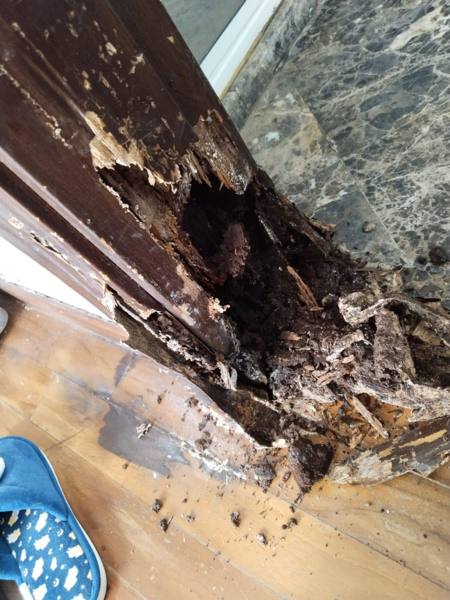
Typical termite damage: the paint is intact but the timber behind it is gone.
Termite frame FAQ
How do I know if termites damaged my door frame?
Tap along the bottom of the frame. If it sounds hollow, feels soft, or you see thin mud lines or powdery debris, termites are likely. Paint can look normal while the timber behind it is eaten away.
Should I treat termites or repair the frame first?
Treat first. A licensed pest-control company should treat the colony and the area. We repair after treatment, so new timber isn't attacked.
Do you use treated timber?
We use seasoned hardwood for repairs and can apply a wood preservative to the new section before finishing.